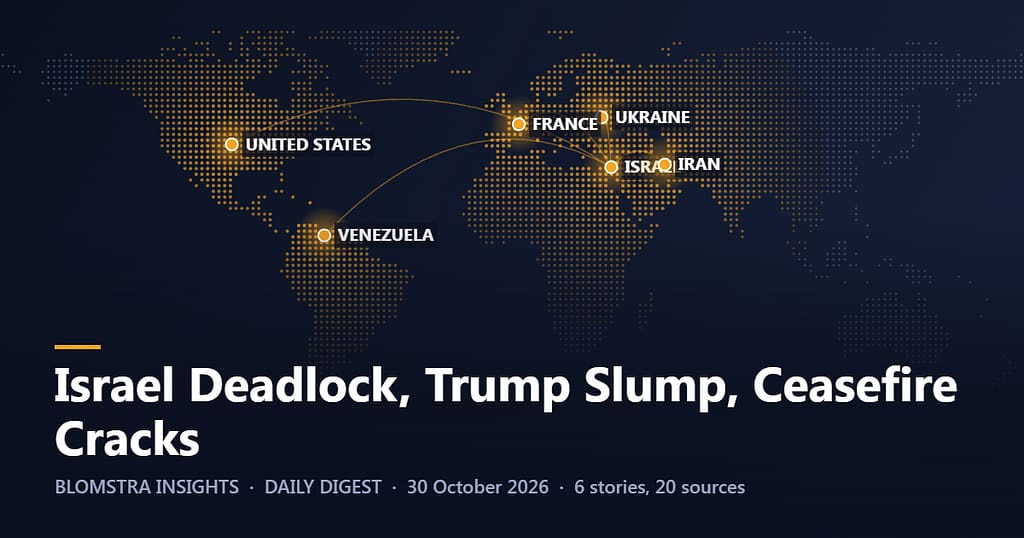

The Iran conflict is being managed as a bounded military choice while its economic architecture expands and its human costs accumulate on merchant crews. The U.S. blockade now reaches the Caspian Sea through Task Force Iron Gate, extending pressure without new strikes. At least 25 merchant mariners have died in nine months, 16 of them Indian nationals. Over the coming months, the diplomatic track will fragment further as Trump prepares a November trilateral with Putin and Xi while Europe presses containment at the G7.
The White House describes the Iran campaign as a deliberate, bounded choice, but the deaths of two dozen merchant mariners and a scramble for great-power off-ramps suggest the conflict’s edges are harder to hold than the rhetoric admits.
01 · The hidden layer
US frames Iran war as contained choice
President Trump told 60 Minutes on Sunday there is “no reason” to escalate the war on Iran and said he was not seeking to do so, while defending the February decision to start the conflict as historically correct. Secretary of State Marco Rubio, speaking to reporters before departing for a G7 meeting in Paris, said the sides are not “at the verge of a breakthrough” and characterized Iranian demands as unacceptable, in some cases outrageous, ridiculous, and unrealistic, according to CBS News. Trump added in a Truth Social post that Task Force Iron Gate “is in full force and effect” to extend the naval blockade to overland routes including the Caspian Sea, a mission U.S. Central Command announced Saturday. Trump is scheduled to meet Qatari Prime Minister Sheikh Mohammed bin Abdulrahman Al Thani at the White House on Monday; Qatar has mediated indirect talks, and Axios sources say Al Thani will seek more time for diplomacy.
Iranian Foreign Minister Abbas Araghchi posted on X that “American voters have made their choice” in the midterm elections and that Tehran’s “2-day proposal stands: meet the requirements, including end to war on all fronts, and you will see results,” or face “alert and battle-hardened Warriors,” according to Al Jazeera. Iran has offered to reopen the Strait of Hormuz within two days if U.S. conditions are met. Trump told CNN by phone Sunday that if negotiations show progress and a “strong agreement” is signed, it is “highly unlikely” the U.S. would resume strikes. Rubio acknowledged the war “isn’t necessarily popular, but necessary” and denied speculation he would leave his post to run in 2028.
Sources: CBS News, Al Jazeera
02 · Who benefits
Shadow fleet seafarers absorb the war’s cost
The US-Israeli war on Iran, launched on February 28, has killed at least 25 merchant mariners according to the International Maritime Organization, with at least 129 shipping incidents recorded over nine months. Al Jazeera reports that October alone saw at least 31 vessels hit. Indian nationals account for at least 16 of the dead, including three killed in June by US strikes near Oman and Gandhar Nahim Ajij from Gujarat killed Tuesday aboard the MSV Al Jusufi off Oman. In October, 12 crew were injured on the Panamanian-flagged On Peace near Oman, Eleven of them Indian. Two Filipino sailors died in September when the Saudi tanker Sidr was struck near the Strait of Hormuz. Iran’s merchant marine union head stated in May that at least 44 Iranian seafarers had been killed and 29 injured. The International Chamber of Shipping called it “unacceptable that throughout this conflict seafarers have been placed in harm’s way.” Before the war, roughly one-fifth of global oil consumption passed through the Strait of Hormuz, which Iran effectively closed while Washington imposed a naval blockade on Iranian ports.
The International Chamber of Shipping called it "unacceptable that throughout this conflict seafarers have been placed in harm's way."
What would change this read: If the International Maritime Organization’s next monthly incident summary records zero commercial vessels struck in the Strait of Hormuz for a full calendar month, the finding that the waterway has become a sustained combat zone for merchant shipping would be contradicted. The IMO documented at least 31 vessels hit in October alone.
Sources: Al Jazeera
03 · Second-order effects
G7 and great-power talks search for off-ramps
G7 foreign ministers meet in Paris on Monday and Tuesday, with US Secretary of State Marco Rubio attending both days, according to France 24. European ministers plan to press the United States to seek a fair settlement for Ukraine and to deter further military action against Iran, including at the suspected nuclear site known as Pickaxe Mountain. Trump told reporters on Friday, “We’re dealing with them now… They want to make a deal very badly,” while European officials say they want a resolution that returns shipping traffic to normal in the Strait of Hormuz.
Trump said on Sunday he expects to meet Vladimir Putin and Xi Jinping at the APEC summit in Shenzhen on November 18-19 to discuss denuclearisation and ending the war in Iran, Euronews reports. The Kremlin acknowledged on October 21 that a trilateral meeting was “being prepared.” The Wall Street Journal reported Putin sought the format to broker a Ukraine peace favourable to Moscow. Sun Yun of the Stimson Center says China wants the image but not the costs. Danny Russel, a former senior State Department official, says Putin has the most to gain. Craig Singleton of the Foundation for Defence of Democracies calls it a potential photo opportunity with diminishing returns.
What to watch
Signals that would confirm or break the readings above.
- Whether the IMO's next quarterly report shows a sustained drop in Indian and Filipino crew deployments on Hormuz-bound voyages compared with pre-February levels.
- Whether the G7 communiqué explicitly endorses the planned Trump-Putin-Xi meeting at the APEC summit in Shenzhen on November 18-19 as a coordinated pressure track.
- Whether Trump authorizes kinetic strikes beyond blockade enforcement before a signed agreement with Iran.
Drafted with Autonom Digest from the sources linked in each section, then reviewed and edited by Blomstra Insights.