
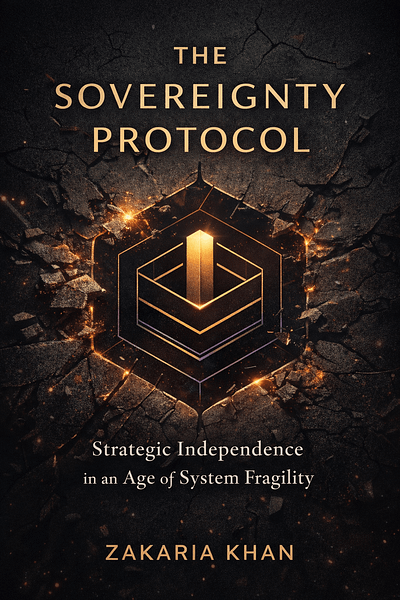
THE SOVEREIGNTY PROTOCOL
Strategic Independence in an Age of System Fragility.
“Modern success is a trap. The blueprint you followed has created a dangerous concentration of risk. This is the architecture for structural independence.”
The “Success Trap”
You followed the blueprint. You did everything right. Good job, good income, good savings. But something feels wrong. You’re successful on paper, trapped in practice. The blueprint that got you here is now your biggest risk.
Income Fragility
100% of income from one employer. One restructuring, one platform policy change, one automation wave—and your entire economic architecture collapses.
Paper Wealth
Net worth locked in illiquid assets. You cannot access your wealth without disrupting your life. You are wealthy, but trapped.
System Dependency
Your security relies on the system’s (banking, platforms, passports) stability. Golden handcuffs tighten with every promotion, every mortgage payment, every optimization.
What’s Inside The Book
This isn’t financial planning. It’s architecture—a systematic approach to structuring your life so you retain freedom of action when conditions change.
The Passenger Era Collapse
Why the “Great Compromise” of the 20th century has ended.
- The 3 Vectors of modern fragility
- Why high-earners are most exposed
The Sovereignty Stack
The three-layer architecture of independence.
- Layer 1: Capital Foundation
- Layer 2: Infrastructure Operations
- Layer 3: Strategic Intelligence
Capital Sovereignty
Moving from Net Worth to “Accessible Optionality.”
- Calculating your Sovereignty Ratio
- Four-layer capital architecture
- Calculating Sovereign Capital Baseline
- Common failure modes & avoidance
Infrastructure Design
Building redundancy in digital and physical systems.
- Passport & Residency Strategy
- Digital Asset Protection
- 5-signal macro intelligence system
The 18-Point Audit
The diagnostic tool to score your current resilience.
- Identify single points of failure
- 4-phase sovereignty construction
- 90-Day immediate action plan
Who This Book Is For
✓ This Book Is For You If:
- You earn $100K-500K/year but feel successful, not secure
- Your net worth is growing but you have no real options
- You sense that income alone doesn’t equal independence
- You want structural clarity instead of tactical reassurance
- You prefer frameworks over formulas, resilience over optimization
- You’re willing to accept honest diagnosis over comfortable narratives
✗ This Book Is NOT For:
- Those seeking guaranteed outcomes or “get rich quick” schemes
- Readers looking for investment tips or market predictions
- Anyone expecting reassurance that the old blueprint still works
- People unwilling to accept that concentration creates fragility
- Those wanting step-by-step prescriptions without thinking
📖 Sample Excerpt: The Paper Millionaire Trap
— From Part III: Capital Sovereignty
Get The Sovereignty Protocol
Choose your format and start building real independence today
🎁 Limited Time Bonus
Get 90 days FREE access to the Sovereignty Tracker tool (value $100+) with your purchase. Includes the 18-question diagnostic, position calculator, and 90-day mission roadmap.
Digital PDF
Instant download. Read on any device. Searchable and portable.
- Instant PDF download
- 50,000+ words, 5 comprehensive parts
- 18-question Sovereignty Audit
- 90-day action plan included
- 90 days FREE tool access
Audio Bundle
Listen on the go. MP3 format. Professional narration.
- High-quality MP3 audio
- ~8 hours total runtime
- Download and keep forever
- Includes PDF version
- 90 days FREE tool access
Available Q1 2026
Print Edition
Physical book. Premium quality. Shipped worldwide.
- Premium paperback quality
- ~300 pages
- Includes digital PDF
- Worldwide shipping available
- 90 days FREE tool access
Available Q2 2026
Direct Digital Delivery via Stripe Encryption. Secure Operational Intelligence.
Acquisition Options
Direct digital access provides immediate secure delivery.
Full PDF Intelligence Briefing including diagrams and the Audit Framework.
Secure DigitalPDF Monograph + Audio Briefing
+ 90-Day Sovereignty Tool Access
Hardcover Archival Edition and Kindle format. Shipped via Amazon.
Order on AmazonDirect Digital Delivery via Stripe Encryption. Secure Operational Intelligence.
Is this about financial independence (FIRE)?
No. The Sovereignty Protocol addresses structural independence, not just financial independence. It focuses on architecture—how your capital, infrastructure, and intelligence are structured—not just hitting a number. Financial independence is often about exit; sovereignty is about leverage and optionality.
Do I need to be wealthy to benefit?
No. The framework applies at any wealth level. In fact, those with moderate means but good architecture often have more sovereignty than high earners with poor architecture. The principles scale.
How is this different from other strategic frameworks?
Most frameworks focus on optimization within stable systems. This framework assumes systems are fragile and designed around discontinuity. It’s architectural rather than tactical, focusing on dependencies rather than returns.
What’s the time investment?
Core reading: 2-3 hours. Completing the Sovereignty Audit: 1-2 hours. Implementation planning: 2-4 hours. Annual review: 2-3 hours. It’s designed for busy professionals.
Related Resources
Sovereignty Tracker Tool
Interactive diagnostic tool with 18-question audit, position calculator, and 90-day roadmap.
Access Tool →Research Archive
In-depth analysis on capital allocation, infrastructure sovereignty, and strategic positioning.
Browse Research →Strategic Intelligence Newsletter
Insights on sovereignty, macro signals, and strategic independence frameworks.
Free Membership→