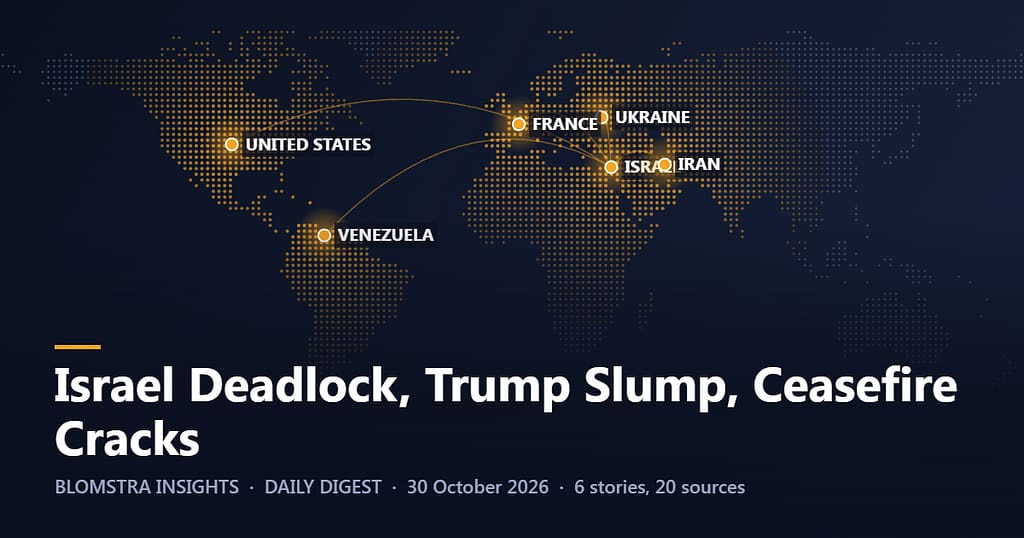

Governments are running contradictory operations in plain sight. The U.S. struck Iran’s Qeshm Island while Vance claimed diplomatic progress hours before midterms. Brent fell 7% on settlement optimism while Ryanair forecast €2 billion in extra fuel costs through 2027. Prediction markets give Democrats a 74% Senate chance, yet Trump retains unilateral war powers regardless of the outcome.
The day opened with a stark contradiction: U.S. missiles hitting Iranian soil while Washington signaled diplomatic progress, encapsulating a week where military pressure and negotiation advance in lockstep. As voters head to the polls, the collision of kinetic action and electoral calculus sets the tone for a global risk picture built on managed contradictions.
01 · The hidden layer
US Strikes Qeshm Island Pre-Midterms
The United States carried out strikes on Iran’s Qeshm Island on Monday, U.S. officials told the Wall Street Journal, which described them as the latest in a series of limited strikes kept quiet in recent weeks to avoid signaling major combat escalation, according to CNBC. A U.S. official told Euronews the operation was defensive, targeting “Iranians using surface-to-air missiles against US asset.” Iranian state media reported five explosions in rapid succession on the island, with some residents reporting two aircraft overhead, according to France 24 and the Guardian.
Hours before the strikes, Vice President JD Vance told CNN that he and President Trump felt “really good about the prospect of potentially coming to a negotiated settlement” with Tehran, adding that Iranians are “unpredictable” and Trump retains “kinetic and non-kinetic” options, CNBC reports. Trump posted on Truth Social that “Iran wants a settlement, as soon as possible. It could happen!” according to Euronews. Iranian Foreign Minister Abbas Araghchi confirmed indirect talks via mediators, naming Qatar and Pakistan as playing “a very active mediating role,” Euronews reports.
The strikes came on the eve of U.S. midterm elections in which Republicans are fighting to retain Congress, with the war cited as a factor in Trump’s declining approval over economic consequences, Euronews and the Guardian report. Last month Trump said the U.S. would not attack Iran before the midterms after polls showed only 31% of Americans supported military action, according to CNBC. Shipping through the Strait of Hormuz, which normally carries around a fifth of the world’s oil, has been heavily disrupted since the war began in late February, Euronews and the Guardian note. Oil prices fell more than seven percent Monday on optimism over a possible deal, France 24 reports.
Qeshm Island, the largest in the Persian Gulf near the Strait of Hormuz, has been targeted multiple times during the war and is reported to hold anti-ship missiles, mines, drones, and attack craft in underground tunnels, CNBC reports. The Guardian notes Iran has continued enforcing its closure of the strait by targeting oil tankers and vessels even as attacks ceased in recent weeks. The Pentagon referred questions to U.S. Central Command, which did not immediately respond to Reuters, according to France 24.
Sources: CNBC, Euronews, France 24, The Guardian
02 · The contrarian reading
Trump’s Iran Policy: Talks and Threats
Multiple U.S. officials told CBS News on Monday evening that American forces launched limited defensive strikes at Iranian targets near the Strait of Hormuz, directed at Qeshm Island in response to Iran’s Revolutionary Guard Corps firing upon a U.S. aircraft. The Wall Street Journal first reported the strikes, according to CBS News. President Trump on Monday signaled progress in talks with Iran, writing on Truth Social that a deal “could happen” and that “Iran wants a settlement, as soon as possible.” Vice President JD Vance told reporters the same day: “We’ve certainly made some progress. We’ll see if we can make some more.” Oil prices plunged more than 7% on Monday on optimism over a possible end to the eight-month-old conflict, and Trump pointed to the drop in his social media post.
Trump told reporters he spoke with Israeli Prime Minister Benjamin Netanyahu on Saturday and had a “very good talk” about the war in Iran, according to CBS News. Netanyahu’s office offered no public comment. Some Israelis worry Netanyahu might attack Iran again to salvage his political standing after his bloc lost its parliamentary majority in last week’s elections, CBS News reports. Speaking to Right Side Broadcasting Network in Iowa on Sunday, Trump said: “We’ve had such a victory, and we’ll put it away very soon, one way or the other. Either they’ll make a deal, or we’ll just end it.” Iran’s top diplomat Abbas Araghchi said consultations with mediators are ongoing and the outcome depends on U.S. answers to “Iranian questions,” adding Iran hopes Washington chooses “diplomacy over other paths.”
A vessel was struck Sunday by an “unknown projectile” in the Strait of Hormuz, Britain’s UKMTO maritime agency said, after Qatari media reported an earlier attack Friday on the LNG carrier Al Mayeda belonging to Qatar Gas Transport Company. Since the war began in February, Iran has been targeting vessels in the strait to assert control over shipping, according to CBS News. Two Iranian officials told ABC News their delegation left Qatar after days of discussions but messages with the U.S. continued through the mediator. Tehran has offered to fully open the Strait of Hormuz within two days if Washington meets several conditions. New supreme leader Ayatollah Mojtaba Khamenei met with military chiefs and said the response to any threat from the U.S. or Israel should be immediate and without “geographic limits,” according to ABC News. Iran’s security chief Mohsen Rezaei warned on X that any attack would bring “devastating blows on the aggressor using new weapons.”
In Tehran, Iranians are flocking to cafes for respite from soaring inflation and the specter of renewed war, AFP reports via CBS News. Mitra Alipour, 28, celebrating her birthday at a coffee shop, said: “Cafes offer a chance to unwind, to escape the stress of exorbitant prices, war and anxiety-inducing news.” Since the conflict triggered in late February by U.S.-Israeli airstrikes, “everything has become more expensive,” she said. Trump at the Lincoln Memorial on Monday called the conflict “not a war” and said “we haven’t been doing any fighting for months,” adding he hopes voters realize “we had to stop Iran from having a nuclear weapon” when they go to the polls. France 24 notes Trump promised an “America First” foreign policy pledging to keep the U.S. out of foreign wars, but two years into his second term his administration has been deeply involved in conflicts worldwide.
Mitra Alipour, 28, celebrating her birthday at a coffee shop, said: "Cafes offer a chance to unwind, to escape the stress of exorbitant prices, war and anxiety-inducing news."
Sources: CBS News 1, CBS News 2, France 24, ABC News
03 · Who benefits
Oil Drops on Iran Hope; Airlines Warn
Brent crude dropped more than 6.5% to $105.55 a barrel on Monday, the lowest since 16 October, The Guardian reports. The fall came after Tehran revealed that contacts between Iran and the US to end their eight-month war were continuing. “Consultations through mediators are very intensive. We have presented our conditions and proposals and everything depends on the political rationality of Washington,” Iranian foreign minister Abbas Araghchi said, according to state media outlet IRNA.
Qatari officials tried over the weekend to negotiate the release of more than $6bn in Iranian assets so that Tehran might allow the Strait of Hormuz to reopen, The Guardian reports. US vice-president JD Vance reported “a number of good conversations with the Iranians” and said he was feeling good about the prospects of a “negotiated settlement.” Iran’s supreme leader, Mojtaba Khamenei, had granted “powers” to his government in its talks with the US, the paper adds. Donald Trump, campaigning in Iowa, said Iran would receive “the hammer” unless there was progress.
The price drop sent airline shares higher and pushed down government borrowing costs, The Guardian reports. IAG shares rose 4.2% in London and United Airlines jumped 7% in New York. The yield on 10-year UK bonds fell 10 basis points to the lowest since 22 September. IG chief market analyst Chris Beauchamp called the news “manna from heaven for stock markets” but warned “there is still a risk that Trump will try one last throw of the iron dice after the midterms.”
IG chief market analyst Chris Beauchamp called the news "manna from heaven for stock markets" but warned "there is still a risk that Trump will try one last throw of the iron dice after the midterms."
Ryanair warned that fuel prices will remain high “well into 2027” unless there is a “swift resolution” to the US-Israel war with Iran, BBC News reports. The airline forecasts a €2bn (£1.6bn) higher fuel bill in the short term and said airfares will be “materially higher” next summer, with “double-digit” increases needed. Pre-tax profits fell 16% to €2.4bn in the six months to September as fuel costs jumped 15%. Although 80% of fuel is hedged, the remainder is at elevated cost. Ryanair is considering a temporary wage freeze from April next year as multi-year union deals end, and expects short-haul capacity to remain constrained into the early 2030s. Unite said it had not been advised of any pay freeze proposals and has a multi-year deal covering next year.
Sources: The Guardian, BBC News
04 · A pattern from before
Midterms Test US Policy on Iran, China
Prediction markets on Kalshi show a 74 percent chance of Democrats winning Senate control, the highest odds since the market opened, according to CNBC. The shift follows a New York Times-Siena College poll showing Democrats leading in several battleground states. Separate race markets moved sharply: Texas Senate odds for Democrats rose to 74 percent from 68.4 percent, Iowa to 50 percent from 42 percent on Polymarket, and Kansas to 63 percent from 52 percent, though Kansas has not elected a Democratic senator since 1932. CNBC notes these platforms do not use traditional polling methodologies.
On Iran, DW reports that a Democratic Congress would likely push Trump to focus on domestic issues and expose the war’s financial costs, per Omid Memarian of DAWN. Yet Trump could continue limited strikes without a formal declaration, and both Memarian and Leiden University professor Babak Rezaeedaryakenari said a Republican defeat does not necessarily stop new attacks. Israel’s October 27 election ended in deadlock, and Memarian called the transition period the “most fragile and dangerous” for escalation. A new government in Israel would not fundamentally alter Iran policy, though former military chief Gadi Eisenkot may coordinate more closely with Washington.
Al Jazeera reports Asia-Pacific economies face severe energy shocks from the eight-month conflict. The Philippines, reliant on the Gulf for over 90 percent of crude imports, has been under a national energy emergency since March. The Institute of Southeast Asian Studies says soaring fuel costs drained foreign exchange reserves of Cambodia, Laos, Myanmar and East Timor, while Indonesia, Malaysia, Thailand and Vietnam spent heavily on subsidies. Steven Okun of APAC Advisors said a Democratic Congress is unlikely to force an end to the war, predicting only oversight hearings and a possible impeachment of the defense secretary. Congress can restrict funding but Trump can veto; overriding requires a two-thirds majority Democrats will almost certainly lack.
CNBC’s analysis of S&P 500 returns from 1980 through 2024 shows the index rose an average 13.7 percent in the year after midterms, with positive returns in 91 percent of cases. The S&P 500 gained after all 11 midterms from 1982 through 2022. Divided government produced stronger results: a 15 percent average one-year gain across 15 instances with no single party in control, versus 11.5 percent under unified control. When Democrats held Congress with a Republican president (1986, 1990, 2006), the index averaged a 0.5 percent decline on the reaction day but rose 3.4 percent after a month and 10.9 percent after a year. Ryan Detrick of Carson Group said markets prefer divided government because “you have too much spending one way and too much power” under a wave election. Société Générale cautions that Federal Reserve policy and earnings cycles ultimately matter more.
Sources: DW, Al Jazeera, CNBC 1, CNBC 2
05 · Second-order effects
RBA Hikes to 18-Year High; ECB Pauses
The Reserve Bank of Australia raised its cash rate by 25 basis points to 4.85% on Tuesday, the highest level since November 2008, according to CNBC. The decision was a split vote, with six members favoring the increase and three opting to hold. The consumer price index rose 4.3% in September, up from 4% in August. The RBA now expects inflation to “remain elevated through much of 2027” and not return to its 2%-3% target range until late 2027, three quarters later than previously forecast, citing higher fuel and commodity prices and AI-related investment driving technology goods prices. Governor Michelle Bullock said inflation is “too high,” driven by higher oil prices from the Iran War and stronger domestic spending, adding that “upside risks to inflation are materializing” and additional hikes will come “if that’s what’s needed to get inflation down.” GDP growth slowed to 2.1% in the June quarter from 2.5% in the March quarter. Bullock said a recession is “not our base case at the moment.”
The European Central Bank held its deposit facility rate at 2.5% on Thursday, following a 25 basis point hike in September, CNBC reports. Headline inflation in the euro area hit 3.8% last month, the highest since September 2023, with energy price inflation reaching 18.8% amid Middle East turbulence. President Christine Lagarde said rising energy prices posed upside risks to inflation and downside risks to growth, but that underlying inflation and wages were “broadly stable” and the Council was “not seeing second round effects.” The Governing Council debated a hike but unanimously decided to hold given accumulating uncertainty. Long-term financing costs have risen sharply, with the average 10-year sovereign yield up around 35 basis points. Money markets priced a 67% probability of a December hike. The euro area economy expanded in the third quarter, with manufacturing, digital services and exports boosted by AI-related investments and government spending on infrastructure and defense supporting activity. Lagarde noted rising borrowing costs globally, attributing them partly to “debt issuance by some of the hyperscalers.” Deutsche Bank’s Mark Wall said predicting ECB policy is “becoming more challenging” and expects one more hike to 2.75% in December.
06 · What to watch
Argentina and Abu Dhabi Court AI Investment
Euronews reports that President Javier Milei told the US Chamber of Commerce last month, “We are not going to regulate artificial intelligence. We are going to leave it free.” He is pushing a Senate-pending bill to cut corporate income tax to 15% from 25% for projects of at least $1 billion in AI and other emerging industries. Patagonia offers empty land, cool air, strong winds, and gas from the Vaca Muerta shale formation. Visitor logs obtained by the Associated Press show meetings in recent months between Milei’s team and representatives of OpenAI, Amazon, Google, Oracle, Peter Thiel, and data-center developers. Crusoe, which helped build OpenAI’s flagship Texas campus, sought talks with Argentine energy officials about US government-backed investments, according to Foreign Ministry records. Green Capital plans a $3 billion data center in Patagonia to lease to big tech for AI computing, though it has yet to secure a customer. Head of international development Marta Zlotkowska said, “We compared potential locations for the project around the world and Argentina, well, Patagonia, came out on top in every category.” She added that in densely populated parts of the US and Europe, “there’s a lot of fighting over access to the grid and who should get the electricity.” Milei’s proposed incentives do not require companies to reserve computing capacity for local consumption or disclose energy and water use. Alan Rocha Varsanyi of Observatorio Petrolero Sur said, “The computing capacity will be exported wherever OpenAI or the other companies need it.” Computer science professor Nicolás Wolovick warned, “Without rules, Argentina will become a laboratory, like when companies go to developing countries to test strange drugs they can’t test in major developed countries.”
CNBC reports OpenAI signed deals across sectors including energy, investment, and government in the United Arab Emirates as part of a $20 billion funding round co-led by UAE investors. CEO Sam Altman met Khaled bin Mohamed bin Zayed Al Nahyan, crown prince of Abu Dhabi and Chairman of the Abu Dhabi Executive Council. Abu Dhabi-based MGX co-led Anthropic’s $30 billion raise in February and OpenAI’s $122 billion raise in March. ADNOC and G42 agreed to deploy OpenAI’s frontier technology. Mubadala, Inception42, and OpenAI signed an agreement to apply advanced AI to investment analysis. The Abu Dhabi Government announced an initiative to translate government policies and regulations into machine-readable form. Inception42 and OpenAI signed a five-year agreement to enable adoption of frontier AI across sectors such as government, enterprise, and education. Altman stated the UAE is “setting a bold, global standard for AI integration across both the public and private sectors.”
07 · What happened
Kherson Fighting Resumes After Ceasefire Collapse
BBC reports that fighting has resumed in Ukraine’s Kherson region after a six-day truce, the longest since Russia’s full-scale invasion began in 2022. The ceasefire allowed hundreds of people trapped in the Russian-occupied town of Oleshky and surrounding areas to be evacuated.
On Monday morning, local authorities confirmed strikes had restarted, saying Moscow hit a medical facility in Kherson city centre. They also said a 62-year-old woman and a 73-year-old man were injured when a Russian drone attacked their car. Ukraine’s General Staff accused Russian forces of using the humanitarian pause to strengthen positions, rotate units, expand anti-drone equipment on roads and deliver ammunition. “The enemy used the humanitarian pause to set up their positions,” the General Staff said. Kremlin spokesman Dmitry Peskov said it was “reasonable to assume that the Ukrainian army also used this period for the necessary regrouping,” calling it “a completely standard practice in such situations.”
Russia’s human rights ombudsman Yana Lantratova and her Ukrainian counterpart Dmytro Lubinets oversaw the ceasefire, travelled into Oleshky and were filmed speaking to residents together. Both publicly thanked each other and highlighted that no violations had been observed. Lantratova and Lubinets called for the initiative to be repeated elsewhere, and Ukraine said it would be prepared to observe similar ceasefires nationally. The Kremlin dismissed the idea even as the ceasefire was under way, with Peskov calling Oleshky “an isolated case” that would not affect the “settlement process.” He reiterated on Monday: “There are no similar plans or initiatives.” Meanwhile, Russian air strikes continued elsewhere in Ukraine, killing scores of civilians and destroying infrastructure.
The ceasefire was brokered by US First Lady Melania Trump, and both Kyiv and Moscow thanked her repeatedly, though no details of her involvement were shared. Commentators linked the truce’s observance to her reported role. Artyom Sheynin, a prominent figure on Russian state TV, said: “I totally get why our official representatives need to ‘play along’ with the US first lady on Oleshky… create a ‘success story’ ahead of the elections for the US president, whose wife ‘achieved a ceasefire’ in Oleshky.” Ukraine had its own reasons to comply: it relies heavily on US intelligence and US-made Patriot air defence missiles to counter Russian aerial attacks, especially ahead of another winter of war.
Sources: BBC News
08 · The hidden layer
Emerging Markets Face Elections, Conflict, Trade Cuts
DW reports that incumbent President Iliana Yotova won Bulgaria’s presidential runoff with 57.6% against Andrey Gyurov’s 39.5%. The vote split along generational and geographic lines: voters aged 18-40 favored Gyurov, while those over 40 backed Yotova; Gyurov dominated in Sofia, Yotova in smaller towns and villages. Yotova, backed by Prime Minister Rumen Radev and the ruling Progressive Bulgaria party, campaigned against military aid to Ukraine and for dialogue with Russia, declaring at a rally: “As long as I am president […] not a single Bulgarian soldier will go to Ukraine.”
BBC News reports that President Donald Trump notified Congress of his intention to remove Rwanda and South Africa from the African Growth and Opportunity Act (AGOA) effective January 1, 2027. U.S. Trade Representative Jamieson Greer cited practices inconsistent with eligibility requirements: for Rwanda, barriers to U.S. trade and investment, human rights, political pluralism, rule of law, workers’ rights, and Treasury sanctions for allegedly directing troops alongside M23 rebels in eastern DR Congo; for South Africa, citing corruption and diplomatic friction, including Trump’s “white genocide” claims. South Africa’s Trade Minister Parks Tau called the decision “unfortunate” and said the country would accelerate export market diversification.
DW reports that the IMF forecasts Ethiopia’s real growth at 9.2% for the 2025–26 fiscal year, driven by agriculture and mining, as well as electricity generation. However, renewed fighting in the north threatens recovery. A World Bank assessment puts damage from the 2020–2022 Tigray war at over $22.6 billion, economic losses around $6 billion, and reconstruction needs at approximately $19.7 billion. Ethiopia lost AGOA benefits in 2022, defaulted on a Eurobond in late 2023, and entered an IMF program in 2024. Analyst Abdulmenan Mohammed warns: “If there is a major conflict […] the current economic growth will not be sustainable.”
UN News reports at least five children killed and two injured in a drone attack on a market in Nyala, South Darfur, Sudan, according to UNICEF. A week earlier, drone strikes reportedly killed at least 80 people in an Abyei market. More than 400 children were killed or injured in Sudan between January and September. The FAO warns that in Haiti, 5.9 million people face acute food insecurity, more than one in two, driven by violent insecurity and a strong El Niño causing drier, hotter conditions; inflation runs at approximately 17%. The WFP projects 6.35 million will face acute food insecurity between March and June next year. Meanwhile, in Yemen, the WHO delivered trauma and emergency surgery kits to hospitals in Taiz City facing acute shortages.
What to watch
Signals that would confirm or break the readings above.
- Whether the Strait of Hormuz reopens to commercial traffic within the two-day window Iran offered mediators, per Guardian reporting on Araghchi's conditions.
- Whether the RBA's next CPI print comes in below 4% while GDP holds above 2%, testing the board's split hike rationale.
- Whether Rwanda and South Africa secure alternative trade blocs within six months that offset AGOA losses, per BBC reporting on the January 2027 cutoff.
Drafted with Autonom Digest from the sources linked in each section, then reviewed and edited by Blomstra Insights.